
For the last four months, I’ve been working as a CX advisor with an Emmy nominated digital agency on a cutting-edge project at the intersection of product design and cinematography, where nearly 100% of the content is generated by AI.
The creative team uses over a dozen different tools, from text and image generators to complex compositing and video systems.
It’s my first experience in such an environment, and here’s what I’ve learned so far.
- Humans are still essential.
Designers, illustrators, sound producers — none of them lost their jobs. Nothing works without them.
AI tools are hopelessly uncreative. They can only follow instructions, and even then, not always the ones you actually meant. - Prompting isn’t a new profession.
Learning to give instructions to models is a skill, yes, but it’s really just a new form of communication. Models evolve, their limitations shift, the “language” changes. Working with them is a constant dance around constraints, not a discipline on its own.
Sorry, but “prompt engineering” is not the profession of the future. - Structured prompts ≠ structured thinking.
Even if you feed a model a neatly formatted JSON, it still reads it as text.
Building a unified command system that produces consistent, controllable results is far from trivial, it’s like negotiating with a neighbor’s child, really. - The first draft comes faster than ever.
The speed of initial generation has exploded by hundreds or even thousands of times. And that’s wonderful.
But small iterative changes? Almost impossible. You can hardly “nudge” an AI output; you end up regenerating everything again and again. The precision of craftsmanship is replaced by probability calculation. - The human touch is still the finishing layer.
An AI artist still needs to work with standard image-editing tools to be effective.
Post-processing feels like rescuing an imperfect photo: retouching, color balancing, bringing it back to life.
The only difference is that AI never gives you a RAW file. - The new waste problem.
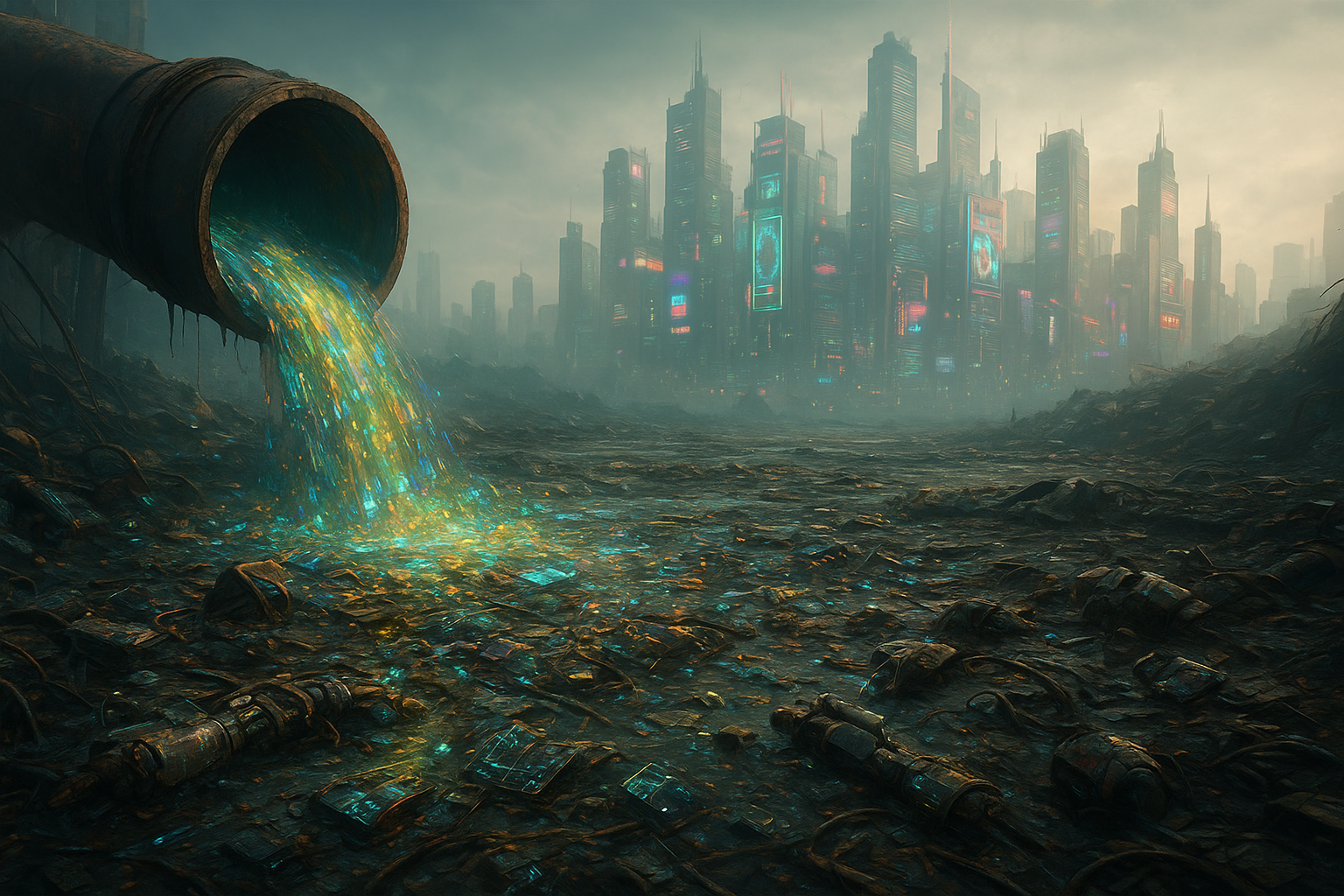
AI creates an avalanche of digital junk — rejected versions, failed generations, endless glitches.
In traditional design, there was simply no time to produce so much garbage.
So, I’ve been paying a lot of attention to what was happening, and so far it looks like sofar AI is a new stage in the production cycle, not a fully autonomous end-to-end process as it was marketed to me.
Like every new technology before it, AI opened new possibilities, but it didn’t replace the need for human sense-making.
And that brings me to the real issue: the digital ecology.
The disk space, the processor time, the electricity, the heat, all consumed to produce countless variations no one will ever use.
After decades of making production leaner and more sustainable, this feels almost criminal.
And here’s the paradox: while AI accelerates production, it can’t create meaning.
The narrative, the creative story behind what you make, will still have to come from you.
And as more content floods the world, the demand for authenticity in ideas, in emotions, in design, will only grow.
From where I sit now, I look at the rising noise of generated content and think of the London smog:
a by-product of progress that once seemed unstoppable, until we realized it was choking us.